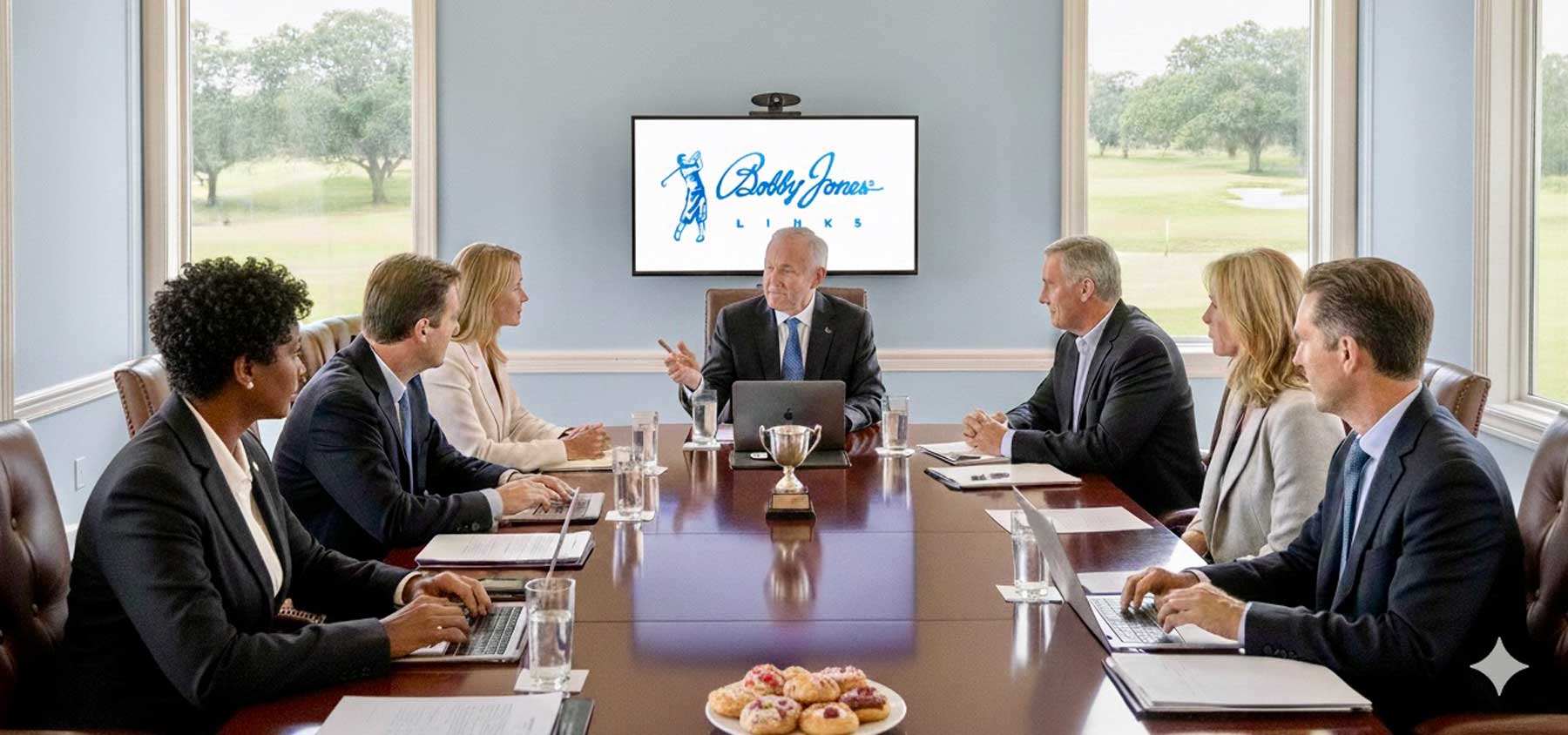





Golf course owners face a crucial decision when choosing a management partner. Our presentations all tend to look alike. The promises we all make are familiar: national buying power, expertise, standardized systems, extensive experience, and centralized marketing. Undoubtedly, these are significant benefits for a club owner.
But beneath the fundamental question that rarely gets asked directly:
Will your club be a priority — or a portfolio line item?
At Bobby Jones Links, we believe that questions determine everything that follows — service levels, the club’s culture, the number of club visits, and owner satisfaction, among others.
If your club feels like it’s being absorbed into a system rather than managed with a customized strategy, it may be time to reconsider what type of management company you choose.
The very largest national operators lead with scale. Hundreds of properties. On the surface, that sounds like strength. In reality, it often creates distance.
As a management company grows beyond a certain size—especially when driven by private equity return objectives—decision-making shifts to a centralized process. Customization makes way for standardization. Local nuances are replaced by corporate efficiency. General managers rotate more often. Superintendents become interchangeable. Budgets are replaced with standardized templates. The result?
Your club becomes one of many. Not the focus — but a fraction. What gets lost in that structure is something critical: stewardship.
Golf and country clubs are not franchises; each of the more than 14,000 golf facilities in the U.S. has its own distinctive qualities. Their history, club culture, community connections, amenities, staffing, and other aspects demand management approaches that cannot be handled with a one-size-fits-all solution.
Scale has advantages. Procurement leverage matters. National recruiting pipelines matter. Technology integration matters. Bobby Jones Links does this very well.
But scale without intentional oversight becomes bureaucracy. The question is not, “How many clubs do you manage?”
The question is, “How much attention will you give mine?”
A right-sized management company like Bobby Jones Links can deliver purchasing power and operational expertise without sacrificing focus.
Ownership structure absolutely drives a management company’s behavior.
When a management company is private-equity backed, growth velocity, exit multiples, and EBITDA stacking become central priorities. That shapes decision-making.
But Bobby Jones Links is employee-owned and not for sale. That difference changes everything.
It means decisions are made for long-term performance, not short-term optics. Corporate support exists to strengthen clubs, not extract margin. BJL’s leaders think like stewards and owners, not portfolio managers.
Every one of those 14,000-plus clubs has a unique footprint, market reality, labor market, culture, and owner expectations.
Cookie-cutter programming can undermine member and customer experience. Uniform F&B models ignore regional preferences. Identical marketing playbooks flatten brand differentiation.
Those complexities require strategy, not templates.
%20(1).jpg)
Clubs that receive focused, increased oversight perform better because our management is proactive across all areas of operations. Strategy, training, systems, business plans, etc., are tailored to each club rather than relying on a standard playbook.
That level of execution demands attention. And attention needs bandwidth – which BJL definitely has. It’s one of the reasons why Bobby Jones Golf Course won the 2025 Jemsek National Golf Course of the Year award.
There is a strategic sweet spot in Bobby Jones Links’ management.
We are large enough to deliver the advantages of the mega management companies, but small enough to ensure access to owner and senior leadership, customized strategies, and cultural alignment.
Ask how many clubs each regional vice president oversees and how many times per year they will be at your club. Ask about turnover. Ask who owns the majority of the company, and whether they will be working on your club?
If you feel fortunate just to be “in the portfolio,” you’ve already ceded leverage. The right partnership should make you feel prioritized, not processed.
Before renewing or entering a management agreement, please ask: Are we a priority — or a number?
Start being the priority in the right one – Bobby Jones Links.