Your club and the club management business are likely to change more in the next 10 years than they have in the last 40.
One conclusion consistently shared across industry experts and today's leading AI platforms is that by 2036, leading golf management companies like Bobby Jones Links will increasingly resemble technology companies that happen to operate clubs. The sentiment among industry leaders is that our most valuable assets will not just be our highly experienced managers or our scale—they will be proprietary AI models, integrated data platforms, and operational knowledge derived from hundreds of millions of member and guest interactions.
Today, our clubs use dozens of disconnected systems:
In ten years, these will operate under a single integrated AI platform.
Instead of managers searching for information, AI will answer questions such as: "Why are food costs up 2.3% this month?" Or "Which members are most likely to resign in the next 30 days?"
Every club leader will have an AI dashboard—or even a conversational digital avatar—that can answer questions, explain trends, and recommend actions.
Today, our General Managers spend considerable time on tasks such as answering emails, preparing reports, scheduling, developing budgets, handling complaints, and reviewing invoices.
AI will automate much of this.
A General Manager might simply say: "Prepare for tomorrow's department head meeting."
The AI will automatically prepare information such as financial dashboards, weather, labor forecasts, member complaints, upcoming events, maintenance priorities, F&B inventory issues, and staffing shortages.
Meeting preparation will shrink from several hours to just minutes.
Today, we learn that members leave after they resign. Future systems will predict departures months in advance.
Indicators might include declining rounds, fewer dining visits, slower email open rates, canceled reservations, reduced guest play, reduced spending, or a spouse no longer attending events.
An AI program might say to a club manager: “Mr. Jones has an 84% chance of resigning within six months.”
It will recommend solutions such as a dinner invitation, a complimentary lesson, a meeting with the General Manager, or a personalized event invitation.
Retention becomes proactive instead of reactive.
Every club will have a living digital twin. Imagine opening an interactive 3D map showing:
Managers will virtually "walk" the property before arriving.
The industry already offers this technology. While today's systems are not yet fully autonomous or highly precise, they are getting remarkably close.
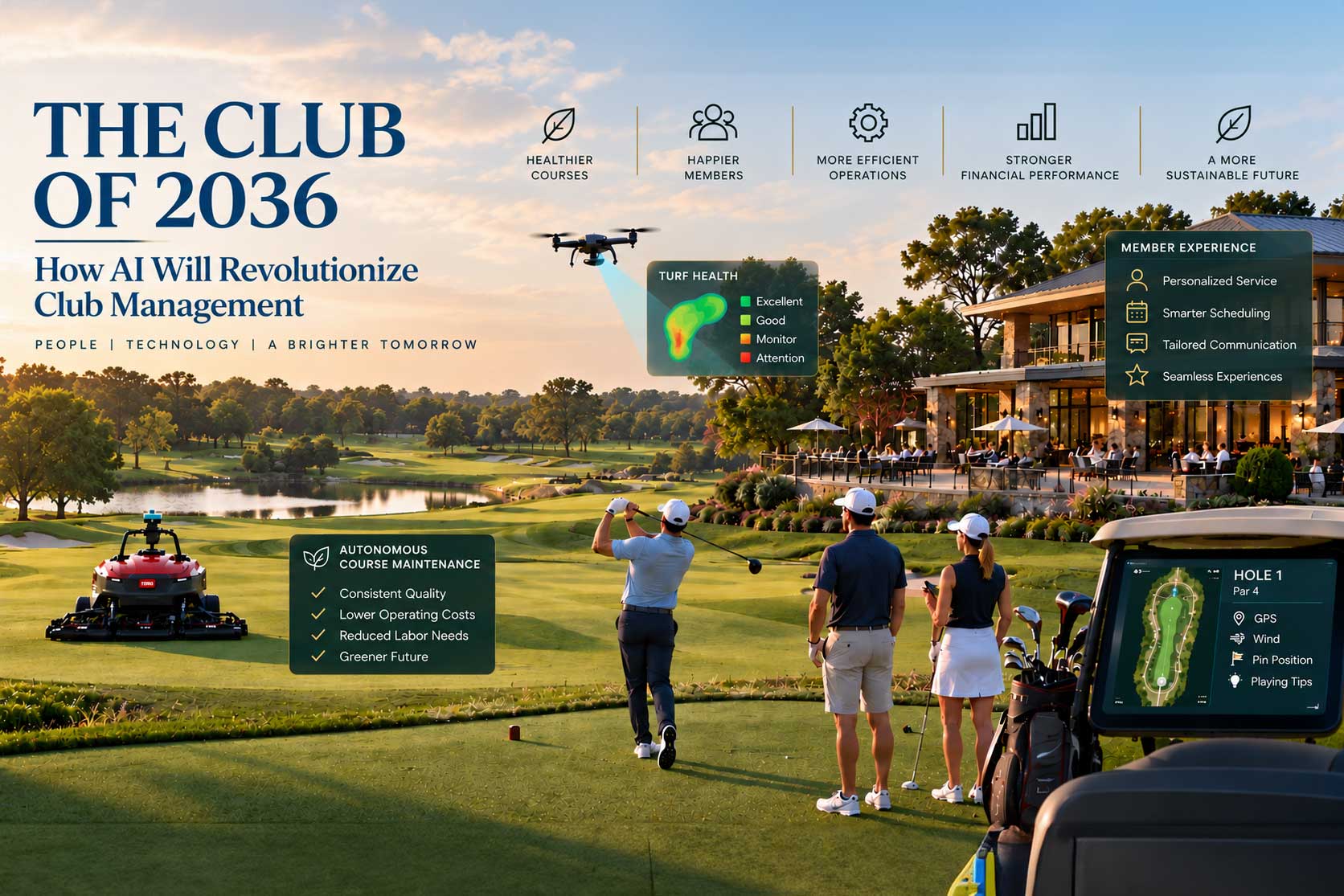
In 10 years, clubs will likely see fleets of robotic greens and rough mowers, bunker rakes, fairway spot sprayers, range pickers, and autonomous utility vehicles. And each machine will communicate with the others.
The maintenance staff shifts toward oversight and specialized work rather than repetitive mowing.
Every acre will generate data. Sensors will monitor moisture, nutrients, disease risk, compaction, salinity, evapotranspiration, and root temperature.
And then an AI system may recommend something like:
“Irrigate greens 4, 8, and 15 for an additional 20 minutes tonight,” or “delay the planned fungicide application on the greens by four days.”
Chemical and water use may decrease substantially while improving playing conditions.
Labor is our biggest expense, sometimes accounting for up to 60% of a club’s operating budget. Future scheduling systems will factor in the weather, upcoming events, tee times, dining reservations, historical demand, PTO status, and employee preferences.
Staff schedules will update automatically, and department heads will spend far less time creating them.
This is where it gets even better: AI systems embedded in equipment will continuously monitor performance.
For example, the system may warn that a greens mower’s hydraulic pump is likely to fail within the next 31 operating hours.
Repairs happen before breakdowns. Downtime decreases significantly.
Every member or customer will effectively have a granular profile of their preferences.
For example, at a private club, AI will tell us that Mrs. Wilson:
The staff will receive prompts before the member or customer arrives. The experience feels highly personal while remaining scalable.
Instead of logging into software, club managers and department heads will ask:
"Show today's labor in dollars and hours scheduled."
"How many memberships have we sold this month compared to the budget and last year?"
“How many outing golf rounds have been played year to date?”
"Prepare this week’s dashboard and email it to the board/owner."
AI voice assistants will interact with every club system.
Instead of ordering supplies manually, AI will predict the club’s needs and place orders automatically.
It may recommend delaying fertilizer purchases, buying golf balls before a price increase, consolidating food deliveries, or shifting purchases among vendors.
Management companies like ours will gain even greater purchasing leverage.
Monthly financial reviews become continuous. An AI automatically identifies issues such as labor variances, payroll anomalies, theft indicators, purchasing irregularities, food waste, and shrinking margins.
Our management teams will receive explanations, not just reports.
The marketing department will become more productive.
AI will create newsletters, social posts, emails, videos, event flyers, website updates, and advertisements.
Each version will be automatically personalized for its intended audience.
Membership and special event salespeople will receive guidance, such as:
Sales effectiveness will become more measurable and consistent.
Instead of reviewing last month's results, we will ask:
"What problems will the club likely have next month?"
The AI dashboard may answer:
Leadership shifts from reacting to anticipating.
The big change is that management companies will not only offer scale and personal relationships but also provide dramatically greater intelligence, predictive insights, and operational capabilities.
In addition to these changes, the winners will be those who can learn from every club and apply those insights across all others. Every improvement, innovation, or best practice developed at one property could be shared with every other club in the portfolio almost immediately.